
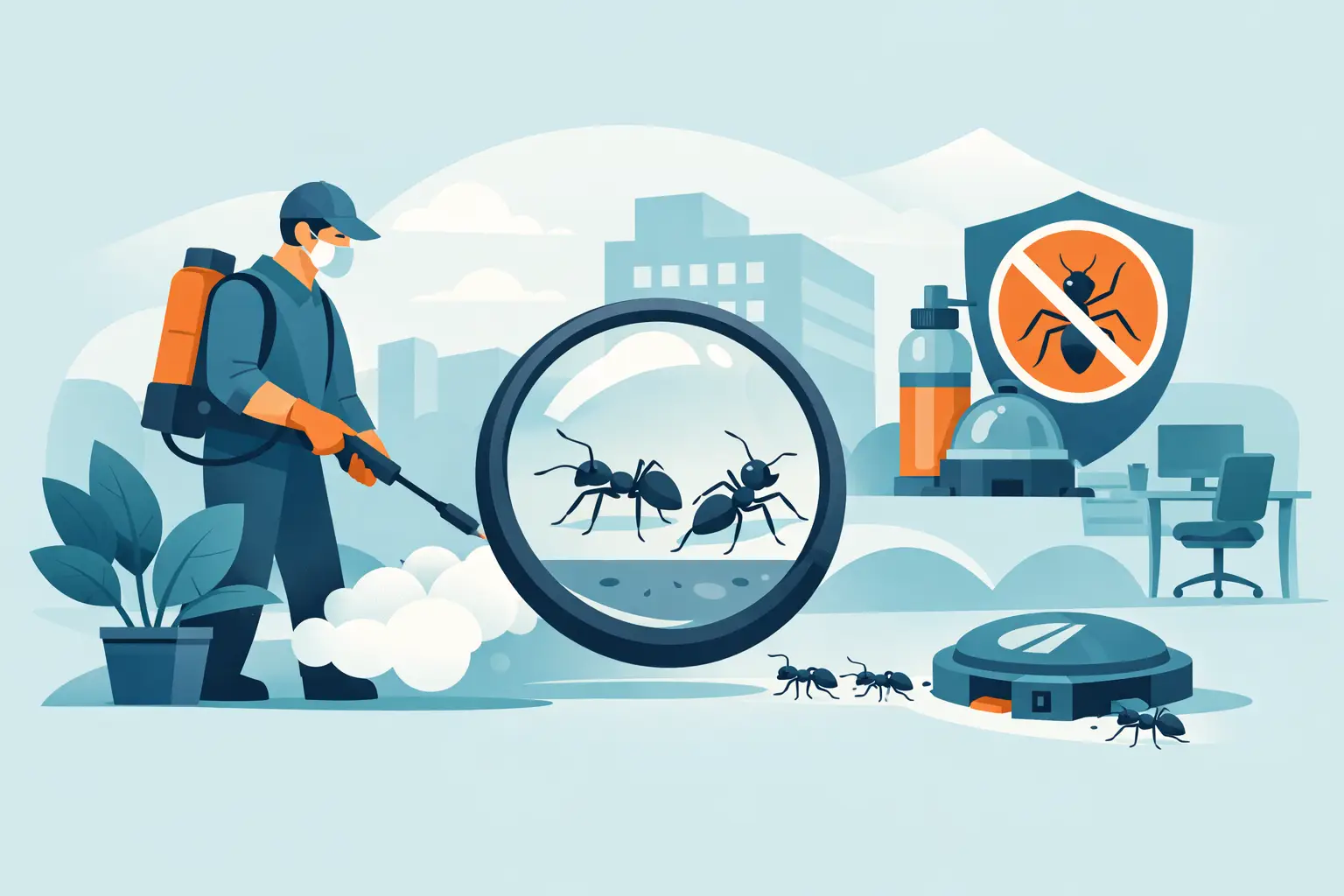
One trail of ants across a lobby floor can turn into a customer complaint fast. In a restaurant, office, warehouse, daycare, or retail space, ants are more than a nuisance – they create sanitation concerns, distract staff, and make your business look less controlled than it is. A professional commercial ant control service helps stop the visible activity, find the source, and reduce the chance of the problem coming right back.
For many South King County businesses, ants show up in waves. You clean the counters, wipe down the break room, maybe even try store-bought bait stations, and things seem better for a few days. Then the trail reappears near a sink, loading door, utility room, or baseboard line. That usually means the colony was never fully addressed, or a second nesting site is active nearby.
Why commercial ant problems keep coming back
Ants are persistent because commercial buildings give them exactly what they need – moisture, warmth, food access, and plenty of hidden entry points. Even well-kept properties can have tiny cracks around doors, plumbing penetrations, window frames, and foundation lines. Once scouts find a food or water source, they leave a chemical trail for the rest of the colony to follow.
What makes business properties trickier than homes is the mix of traffic and structure. Employees may eat at desks, janitorial schedules can vary, inventory moves in and out, and customers open doors all day long. In restaurants and food service spaces, grease, syrup, crumbs, and floor drain moisture can attract ants quickly. In offices and medical buildings, break rooms and restrooms are common hotspots. In warehouses and multi-tenant properties, the issue may start in one area and spread before anyone realizes it.
That is why surface spraying alone is rarely enough. If treatment only targets the ants you see, the colony may survive behind walls, under slabs, in landscaping, or around exterior foundations.
What a commercial ant control service should actually include
A reliable commercial ant control service is not just a quick spray and a bill. It should start with a clear inspection and a plan that fits the property. Different ant species behave differently, and the treatment approach should reflect that.
A proper service usually begins by identifying activity patterns. Where are ants entering? Are they nesting inside or outside? Are they being drawn to food, standing water, trash areas, or structural gaps? These details matter because they shape where products are applied and what prevention steps will make the biggest difference.
Inspection first, treatment second
The best commercial service starts with the source. That means checking kitchens, mop closets, utility lines, break rooms, exterior perimeters, dumpsters, landscaping edges, and any place where moisture collects. If a provider skips that step, you are more likely to get temporary relief instead of a lasting result.
Targeted products and application methods
Ant control in commercial spaces often involves a mix of treatments. Baits can be effective when ants are actively foraging and carrying material back to the colony. Non-repellent products can help control ants without scattering them into new areas. Exterior barrier treatments may reduce reinfestation pressure around the building. In some situations, exclusion and sanitation corrections are just as important as the product itself.
There is no single treatment that fits every business. A daycare, office suite, restaurant, and storage facility all have different risk points and different operational needs.
Safe treatment matters in active workplaces
For business owners and property managers, safety is not optional. You need a provider that uses EPA-approved products and applies them carefully around staff, customers, food-handling areas, and shared spaces. That matters even more in places like schools, healthcare offices, apartment common areas, and hospitality settings.
The right company will explain what is being used, where it is being applied, and whether any prep is required. They should also understand how to work with your schedule to minimize disruption. In some buildings, treatment can happen during regular hours. In others, after-hours service makes more sense.
This is one area where cheap, rushed service often costs more in the long run. If the work is not done carefully, you may still have ants and now also have frustrated staff or interrupted operations.
Signs your business needs professional ant control now
Some infestations are obvious. Others build slowly until they affect daily operations. If you are seeing repeated ant trails, ants near food prep or vending areas, activity around sinks and drains, or complaints from tenants, customers, or employees, it is time to act.
Another common warning sign is recurring activity after DIY treatment. Retail baits and sprays can sometimes reduce visible ants, but they often miss the colony structure or fail to address multiple nesting points. If the problem keeps returning, that is a sign the infestation needs a more complete plan.
For property managers, even a minor issue is worth handling early. Ants in one suite can spread to neighboring units, and small complaints tend to become larger service issues when they are not addressed promptly.
Commercial ant control service for different property types
Not every commercial property has the same pressure points, so treatment should match the use of the building.
Restaurants, cafes, and food-service businesses usually need close attention to kitchens, floor drains, dish areas, storage shelves, and grease-prone spaces. Ant pressure can rise quickly when moisture and food residue combine, especially during warmer months.
Office buildings often see activity in break rooms, copy rooms, trash collection points, and around exterior doors. Because staff may not report early sightings, the problem can continue in the background for weeks.
Warehouses and industrial spaces tend to have issues around loading docks, pallet storage, employee break areas, and utility penetrations. Large structures can hide nesting sites well, so inspection quality matters.
Retail businesses face a different challenge: visibility. A few ants near a checkout counter or product display can affect customer confidence immediately, even if the infestation is relatively small.
Multi-unit and mixed-use properties need coordinated service. Treating one area without considering adjoining spaces often leads to repeat callbacks.
Why follow-up visits matter
One of the biggest differences between average service and dependable service is what happens after the first treatment. Ant infestations do not always resolve in one visit, especially in larger buildings or properties with long-standing activity. Colonies can shift, fresh ant pressure can come in from outside, and seasonal changes can affect where ants forage.
That is why follow-up support matters. A company that offers unlimited free follow-up visits gives customers a practical advantage. If activity remains or returns, you are not left wondering whether you should pay again just to finish the job properly. That kind of support is especially valuable for businesses that cannot afford recurring pest complaints.
For many properties, ongoing maintenance is the smarter option. One-time service may work for an isolated issue, but recurring service helps catch conditions early and keep pressure down year-round.
Choosing the right commercial ant control service
If you are comparing providers, speed and consistency matter just as much as price. Same-day or next-day availability can make a major difference when ants are affecting staff or customer-facing areas. Local experience matters too, because ant pressure in Kent, Covington, Maple Valley, Auburn, Renton, Bellevue, and South Seattle can vary by property type, season, and surrounding environment.
Look for a company that is licensed and insured, explains its process clearly, and builds treatment plans around your building instead of offering a one-size-fits-all approach. Family-owned providers often stand out here because service quality and local reputation are tied closely together.
Plateau Pest works with businesses across South King County that need fast, affordable ant control without unnecessary disruption. For many local customers, the deciding factor is simple: quick response, safe products, and follow-through when the first visit is not the end of the story.
Preventing ants after treatment
Even the best treatment works better when the property supports it. That does not mean your staff needs a huge checklist, but a few practical changes can reduce future issues. Prompt cleanup of spills, better trash management, moisture control, and sealing small gaps around doors and utility lines all help. For some businesses, landscaping adjustments near the foundation can also reduce exterior nesting pressure.
Still, prevention is not always enough on its own. If your building has structural entry points, heavy foot traffic, or recurring moisture, ants may keep testing the property. That is where professional monitoring and follow-up service become part of the long-term fix.
When ants show up in a commercial space, the real problem is rarely just the ants you can see. The right service addresses the pressure behind the scenes, protects your reputation, and helps you get back to business without turning pest control into another thing your team has to manage alone.