
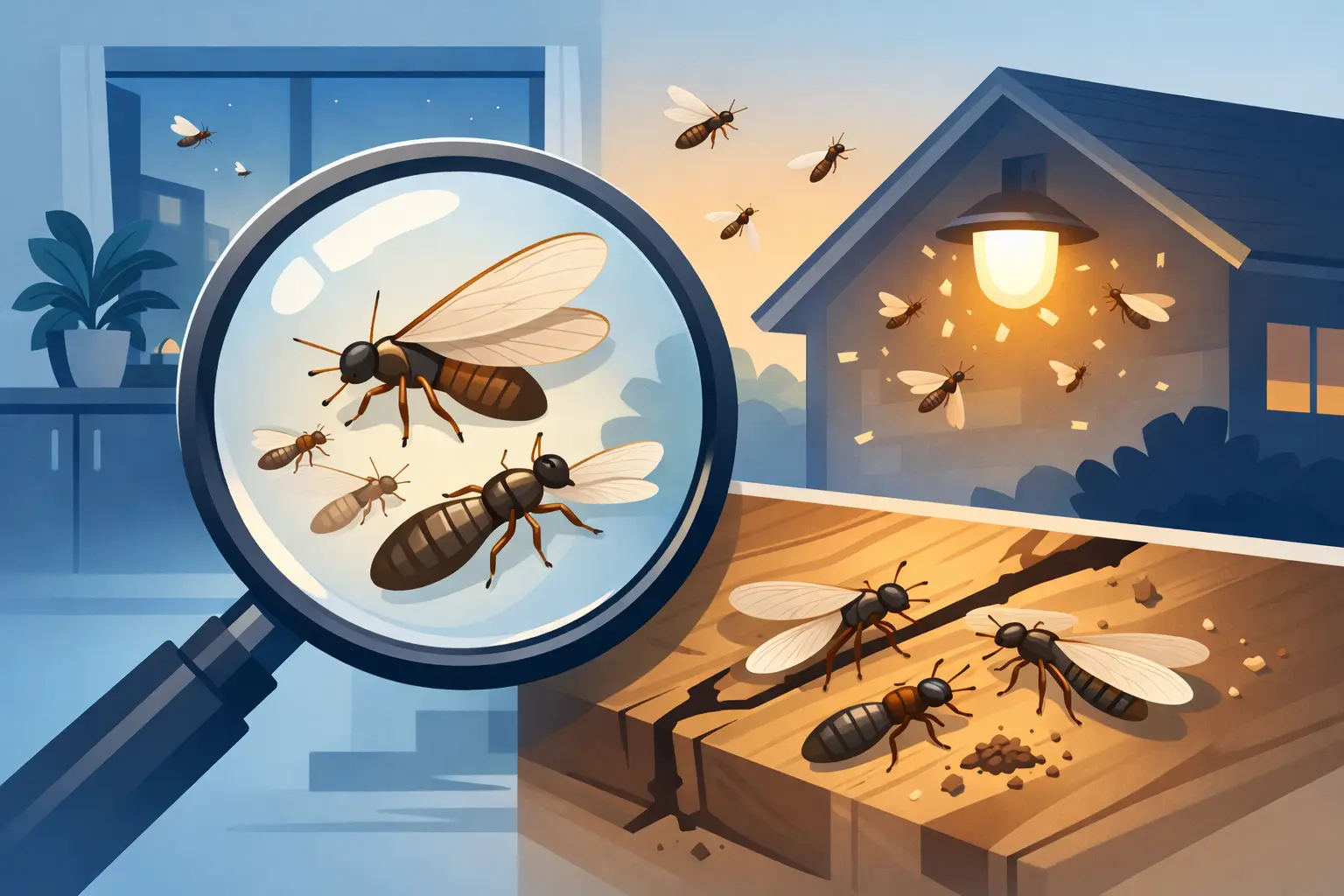
A cluster of winged insects around a window, porch light, or bathroom is easy to dismiss as flying ants. But knowing how to identify termite swarmers can help you spot a possible termite issue before it becomes costly hidden damage. In South King County, a sudden appearance of these insects – or just a pile of discarded wings – is worth taking seriously.
A termite swarmer does not bite people, spread disease, or chew through a home overnight. Its presence is still a signal that mature termites may be nearby. A quick inspection can separate a harmless seasonal insect event from a problem that needs prompt treatment.
What Are Termite Swarmers?
Termite swarmers are the reproductive members of a termite colony. When a colony reaches maturity, it produces winged adults that leave to find mates and start new colonies. This is called swarming.
Swarms often happen when weather conditions are warm and damp, commonly after rain. They may occur outdoors near soil, stumps, woodpiles, or landscaping. If swarmers appear inside a house, however, they may have emerged from an established colony within the structure or immediately beneath it.
The swarm itself may last only minutes or hours. Homeowners often miss it and find the evidence later: small, translucent wings gathered on a windowsill, near a sliding door, in a sink, or around light fixtures.
How to Identify Termite Swarmers vs. Flying Ants
Flying ants and termite swarmers look similar at a glance, especially when they are crawling near a window. The differences become much clearer when you look at the body shape, antennae, and wings.
Look at the waist
A termite swarmer has a broad, straight body with no sharply pinched middle. Flying ants have the familiar narrow, constricted waist that creates a clearly separated thorax and abdomen.
Check the antennae
Termite antennae are straight and bead-like. Ant antennae bend at a noticeable angle, often described as elbowed. This is one of the most reliable ways to tell them apart if you can view an insect closely.
Compare the wings
Termite swarmers have four wings that are nearly equal in length and shape. The wings are long, delicate, and often extend well beyond the insect’s body. Flying ants also have four wings, but their front pair is noticeably larger than the rear pair.
Termites shed their wings soon after swarming. A pile of matching, equal-length wings is often more revealing than the insects themselves. Ant wings may be left behind too, but they will usually show the unequal front-and-back wing size.
Consider the color, but do not rely on it alone
Termite swarmers are commonly dark brown or black, though color can vary by species and lighting. Flying ants may be black, reddish, brown, or yellowish. Because both insects can be dark, color alone is not a dependable identification method.
Where Homeowners Commonly Find Swarmers
Termites are attracted to light, which is why swarmers often collect at windows and exterior doors. Indoors, check window tracks, blinds, bathrooms, basements, crawl space entries, utility rooms, and areas near exterior walls.
Outside, look around mulch beds, old landscaping timbers, tree stumps, woodpiles, fence posts, and foundation edges. Finding swarmers outside does not automatically mean termites are attacking your home. It can mean a colony is present somewhere nearby, which is still useful information when evaluating your property’s risk.
In Kent, Covington, Maple Valley, Auburn, Renton, Bellevue, South Seattle, and nearby communities, homes can be more vulnerable when moisture, wood-to-soil contact, and concealed foundation areas give termites easy access. Leaky spigots, poor drainage, crowded vegetation, and damp crawl spaces can make conditions more favorable.
Other Signs That Support a Termite Concern
Swarmers are a visible warning sign, but termites usually work out of sight. If you find suspected swarmers indoors, look for other evidence without disturbing damaged areas.
Mud tubes along foundation walls, crawl space supports, plumbing penetrations, or garage walls are a common sign of subterranean termites. These narrow, earth-colored tunnels help termites travel between soil and wood while staying protected from dry air.
Wood damage can be subtle. Painted trim may look bubbled or discolored, floors may feel soft in a localized spot, and wood may sound hollow when tapped. In more advanced cases, you may see blistering, buckling, or thin wood surfaces that break easily. These conditions can also result from water damage, so professional identification matters.
Small piles of wings are another strong clue. They are often found in places that receive daylight, even if the actual termite activity is hidden behind a wall, beneath flooring, or under the home.
What to Do If You Find Termite Swarmers
First, avoid spraying a suspected swarm with a general household insecticide and assuming the problem is solved. Killing the visible insects does not address a colony that may be hidden in soil, wood, or a wall void. It can also make it harder to determine where the insects came from.
Instead, collect a few specimens or wings in a clear bag or small container if you can do so safely. Take a close photo beside a coin or another object for scale. Note the room, date, time, and exact location where you found them. This information can help a licensed pest professional identify the insect and assess the situation faster.
Then schedule a termite inspection, especially if the insects were indoors or you also see mud tubes, damaged wood, or repeated wing piles. A thorough inspection should look beyond the room where swarmers appeared. Termite activity can travel through concealed spaces and may begin outside before reaching structural wood.
Do Swarmers Always Mean You Have Termites?
No. A few winged insects outdoors may be flying ants, or they may be termite swarmers from a colony well away from your house. Even confirmed termite swarmers outside do not prove active damage inside.
The situation changes when swarmers emerge indoors. Indoor swarming is more concerning because it can indicate that a mature colony is living in or under the structure. It is not a guarantee of severe damage, but it is a good reason not to wait.
It also depends on what an inspection finds. Some homes have conditions that invite termites but no active infestation. Others may have old, inactive damage from a prior issue. The right next step should be based on current evidence, not guesswork or a one-size-fits-all treatment recommendation.
Prevent Conditions That Attract Termites
You cannot eliminate every termite from the landscape, but you can reduce the conditions that make a home easier to enter and feed on. Keep mulch and soil from covering siding or touching exposed wood. Store firewood and lumber away from the house, and avoid stacking it directly on the ground next to the foundation.
Moisture control is equally important. Repair plumbing leaks, keep gutters and downspouts directing water away from the foundation, and address standing water near the home. Make sure crawl spaces are dry and properly ventilated or managed according to the needs of the structure.
Before making repairs, confirm whether termites are active. Replacing damaged wood without addressing an active colony can leave the underlying problem in place.
When Fast Professional Help Makes Sense
Call for a professional inspection promptly if you find equal-sized wings indoors, see mud tubes, notice damaged or hollow-sounding wood, or observe more than one swarm event. The earlier a termite issue is evaluated, the more options you typically have for protecting the home and limiting repair costs.
Plateau Pest provides practical, local pest support for South King County homeowners and property managers who need clear answers quickly. A trained technician can identify the insect, inspect likely entry points and risk areas, and recommend a treatment or prevention plan based on what is actually found.
A handful of wings on a windowsill may turn out to be flying ants. But if the signs point to termites, acting while the evidence is fresh gives you the best chance to protect your home with confidence.